Showing posts with label career. Show all posts

Sunday, May 15, 2022

Product Management Learning Track @MoveInSync

Once upon a time, I thought I should start a product management course too. There are hundreds of cohort-based courses out there now, but I am talking about a time a little before PM courses were being sold on Fiverr. When they still seemed rare and valuable. 

I recorded the first PM-related intro video in 2015 for an ed-tech platform that doesn't even exist now. Over 2k people loved it and rated it 4.9/5 stars. If 2k looks too small a number to you, let me tell you that it would have been about 10% of the market share then. I was also consulting some big brands for setting up the curriculum for their upcoming product management courses. I also taught classes at some of those "very academic" courses - mostly delivered by folks who come from large corporates. I was invited for giving "practical" insights. So, it shouldn't come as a surprise if I had a feeling that I could do a few notches better than them. 

So, I planned the entire thing, but then, something wasn't adding up. I figured people buy what they want, not necessarily what they need. I strongly wanted to give them only what they need. Unpopular things like ignoring "RICE" and "MoSCoW" frameworks early on, and prioritizing by deeply understanding ROI. 

The guys who wanted to sell my course wanted me to do stuff that would sell. But, I figured I don't want to teach that kinda stuff. I actually did not want to sell at all, I just wanted to teach. I also know that anything done for free gets taken for granted. So, I could not do a free course either. 

Where could I get a sincere audience who would take stuff seriously without paying for it? 

EVIL PLANS

I once got a call from one of my reportees at MoveInSync. She was ranting about how she has been spending week after week firefighting. And I asked her if all this fire wasn't there, what was her plan of action. She had none. While she was puzzled, I was smiling - the smile you have when you get an evil idea. I had 10 reportees at that point and I could see all of them struggle with one thing or the other. Here was my audience. And a great opportunity, because we wanted to build a kickass SaaS product, that can have a "Global" appeal. 

One beautiful thing about MoveInSync culture is that it is very open. Thanks to my reporting manager Videh, at that point, for encouraging me to begin experimenting with a learning series for all young PMs. After a few experiments around a classroom-style model once a month, I figured it's extremely hard to maintain consistency by teaching a common topic to a diverse crowd. I wanted to do something that helps people subscribe to the learning, and not force people into it. 

So here are the details of what eventually worked (and is still WIP). 

12 SKILLS, 12 MONTHS

Some numbers just fit. I found this popular blog from Ravi Mehta. 
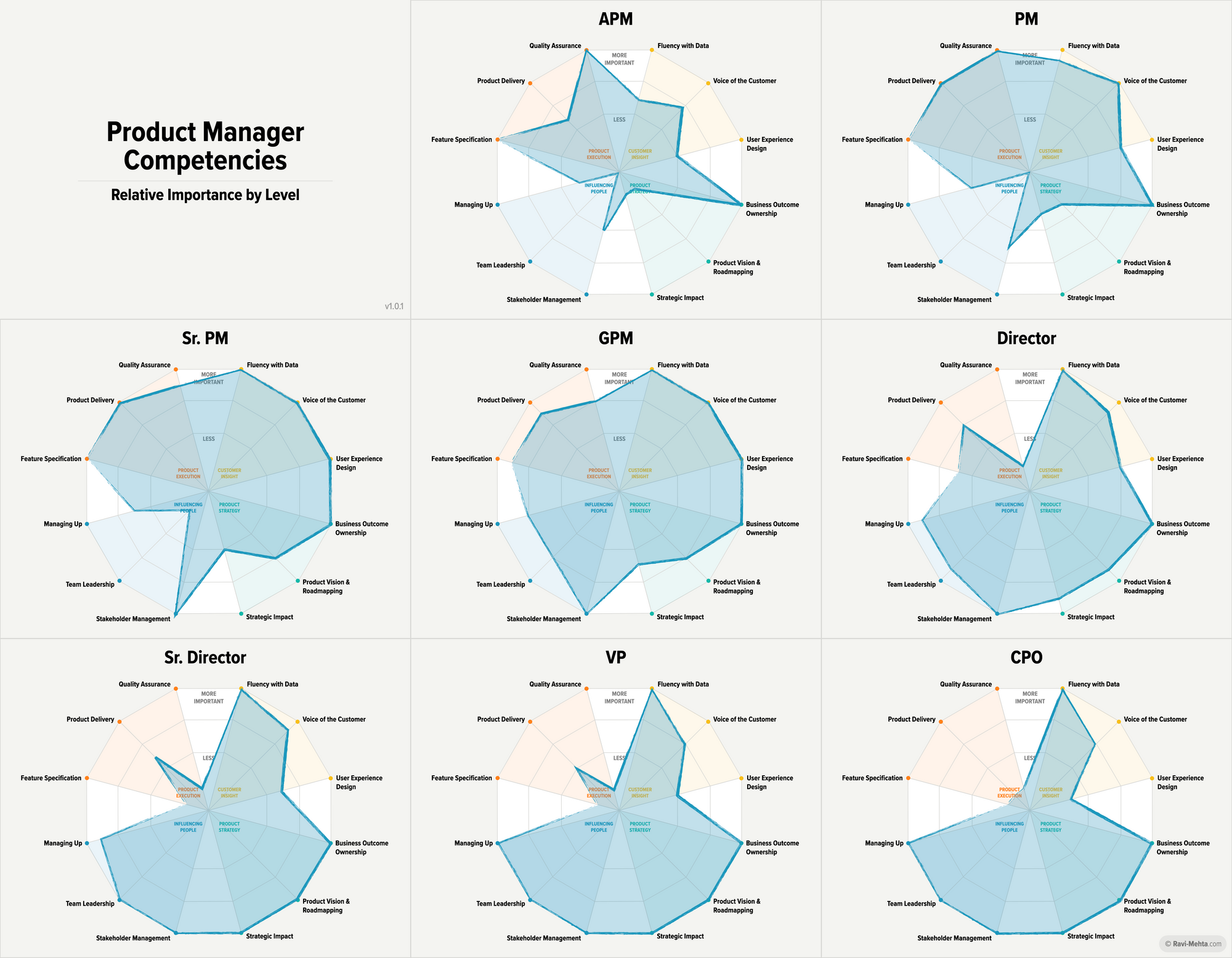

It talks about 12 skills that a PM should possess and practice and how the expertise required in each skill changes as you ride up the career path in product management. As you'd have guessed 12 skills in 12 months looks like a perfect fit. 

Without getting into the debate of the accuracy of this, I'd tell you how it became immediately useful. It was a good way for everyone to do self-evaluation and identify what skills would they want to work on. 

And so, we planned a monthly one-to-one check-in with me - where everyone will review themselves on all 12 params. I'd discuss my evaluation of their skills and gaps. Then we mutually decide what they'd like to focus on learning in the next 1 month. 

Monthly plan

  • Learners should decide and announce what skill they'd focus on learning. 
  • Learners should then study the topic and eventually apply it in their daily work. I'd help get them started with a list of books, podcasts, blog posts, and internet resources that I have saved for my own reference. These are usually things that I have re-read multiple times and have personally found very beneficial. Here's the index. Every time we decide on a topic I send them links from here. And of course, this is just a start. The curious folks, keep double-clicking on the right things and find their own treasures. 
  • They should take notes, take snapshots of "before" and "after" for things they seem to have clearly improved upon, and register it in the workbook (mostly a shared spreadsheet) so that we can discuss it during the next check-in. 
  • Learners should also plan to discuss the topic all through the month with peers and managers to internalize it and apply it effectively.  
  • At the end of the month, we looked at the notes, discuss progress in self-evaluation and decide what should be picked up next. 

This has been really helpful in improving the baseline of product management know-how for everyone in the team. It also gives people enough time and motivation to keep learning new stuff and to keep applying it. And probably I'd skip the part where I tell you how effective it has been for creating an amazing product culture at the organization. I am sure you can imagine it. 

NUANCES

This looks like a perfect plan, but, it isn't. 

  • Not everyone finds this 100% useful. So, it is OK if they would like to take up a different skill like Tech/Digital-Marketing - it can quickly be structured in a similar way. The understanding is that you are upskilling yourself and making defined, structured progress.  
  • Not everyone learns at the same pace. So one can be flexible. Remember there are no annual term exams at the end of the 12-month period. So, it can pretty much be self-paced. People can also take a sabbatical from this and join back the track at any time because everyone is working on their own set of skills. 
  • Not every skill is immediately applicable. There are some skills like documentation that you get to use every day, there are others like road-mapping which may not even apply to a team member (based on their designation).
  • Learning some of these skills (most of the last six) is subject to opportunities. Learning about team leadership is one thing, but actually leading a team of smart folks is another. You only get the experience, when you get an opportunity to do it. It may happen within the course of a year, and it may not. I strongly believe that success is when "opportunity" meets "preparedness". So while one may not get immediate opportunities, one should prepare for them long before one actually gets them. That's what I continue to do for my own learning as well. I read stuff and learn things that may not be immediately useful, but could be useful someday. Also, as a manager, I try to get my folks that opportunity in some form.  
I just thought I'd open source this initiative so that more curious PM leads in different organizations can build more useful, impactful stuff on top of this. 

I'd love to know if you do that, and/or if I can contribute further to your cause. 

--------
PS: Leaving a comment/question helps the author get the motivation to write more. SO DO IT!


Monday, February 1, 2021

How to transition in to a PM role?

Crossing the chasm!

That's one of the most frequently asked questions I get - How do I transition into a PM role or How do I break into Product Management?

Honestly, I don't know. But, I can tell you how I became one. 


Most advice is people giving you their winning lottery ticket numbers. 

- Naval Ravikant


There, Naval said it. So, why should I be an exception?  

I discovered the Product Management role in 2009 (while I was still a Techie), became one in 2013 - and there was no one to tell me anything about what it is like to be a PM - even after I became one. So, all my effort so far has been about making it a little better for the next set of folks coming into this role. 

Disclaimer: This post is for folks playing a long-term game, if you want instant benefits go to this place. Also, if you are already a PM read this. 

From a techie in a services company, my first jump into the business side of things was becoming a trial business analyst. I was a Techie for 5 years, an average coder, a much better team lead (my team told me later). In services companies, you don't need to be a crack hacker. I had the people and communication skills that services companies love. I understood what clients wanted, created great docs, engaged clients, and the team alike, and got shit done. 

One day in a small presentation room cum library cum dormitory, my career took a sudden twist. While I was presenting a case study in a typical management development program that services companies do for "young leaders",  my boss's boss saw me present and he felt I could be a fit for some business role he had in mind. So, we took a trial for 15 days and that was it. Got a chance and made the best of it. I turned from a Techie to a Business Analyst (and eventually a PM).  

They say it takes years for overnight success. And they are right. 

The story doesn't really begin in that small presentation room. It started much earlier when I was just a techie in a services firm. In the corporates, you can do brilliantly well, but your growth is mostly determined by the ominous bell curve. The only way out for a different growth path, as most people suggested, was to mortgage your balls to the banks and do an MBA. 

For someone who had just come out of the clutches of education loan debt, I was either too naive or too possessive about my balls. The freedom of being debt-free is addictive. I couldn't think of getting into bigger debt for education again. So, I decided to pursue what I could. I started to learn whatever was free. 

Enter Coursera. There were professors from Stanford and Penn teaching me marketing, business strategy, finance, and gamification. (The first 4 courses I took). And all for free. I couldn't ask for a better deal. Having collecting 100+ certificates for co-curricular activities in school and college I had a growing disillusionment for certificates. All I cared about was the knowledge and structure coming in video format - much better than reading a book. 

That said, I was quite a hoarder of books as well. There is nothing more spellbinding than the smell of old books on discount sale. That's what I miss from the tonne of ebooks I download. Leadership, Organization structure, Business stories, Physics, Advertising, History, Spirituality, Black magic - I like reading everything. If these things sound like a digression, you've missed the point already. 

The point being, it's hard and there is a lot of time, patience, and hard work required - and it is still based on chance.  

The best PM courses have eased the process a little but they are like all other courses in the world. They help you learn and leave you on your own to go figure. 

So what can YOU do?

Do what you love to do.

Unfortunately, that's it. It is as simple (or as difficult) as that.  

Did I tell you that I started writing blogs in 2006? 

I had blogs for Poetry, Cartoon, Advertising-critique, Business learnings, Newsletter. Some of them are still active, some died down - all are not so good, but I am still proud of some of the stuff I created. That's how I learned, by writing, creating, doing. I was part of a bunch of online communities and created a few of my own. I was part of the social media teams of all organizations that I worked for until it started becoming a specialized role sometime around 2013 (In India). 

While I was still leading a team, I was also doing all these other things - just because I love doing them. In most organizations I have worked with - if you are taking care of your work, anything you do over and above that, is welcome. It may not lead you anywhere. It may not get you the promotion or raise. It may not even get you the award that you deserve. But, it would give you a lot of learning and experience and satisfaction of doing something you love to do. 

At least to me. It did not get me any of those things - at that time. 7 years of toiling and doing stuff I wanted to - that was the reward. My first official appreciation/award came in 6 months into the product role. And then on, I've gotten it at all orgs I've worked with so far. And all the experience and learning come back together when I get into new problems and situations that no one can prepare me for. 

And, did I mention I started up? 

Twice. Among a bunch of other things I did, I also started a T-Shirts printing business on the side. Had huge plans but no real insight about how startups work. Also, I was working with two other friends from college time - all working on the side. We hustled for 6 months and then - "Jimmy quit, jody got married". So while it failed before it could really start - that was one of the most useful of my failures. The other two found their international MBA entry with this startup-failure story, and I still use that experience in product management. 

And, you know I volunteered. Right?

In 2014 I was thinking a lot about how to measure things correctly as a PM (or as anyone in business). How to measure growth, engagement, success for your products or processes? My quest led me to join the Headstart Network Foundation as a volunteer. I asked them how do they measure their impact, they said they didn't. I suggested they should. They suggested I should join them and do it. And that was it. Over the years, the Non-profit has grown and now I have a network of startup folks in 50 odd cities across India, Japan, Berlin, Finland, and London. Not bad for a non-MBA guy. 

Some of these have been strategic decisions, but, most of them I just said yes when the opportunity looked interesting. So, while as a PM we are asked to "learn to say NO", I've almost always taken up a new challenge by saying YES. There are no right decisions, you have to take a decision and then make it right. 

Ok, we've gone past a lot of stories in flashback and flash forward. Let me listicle it for your easy take-home. 

Here's a mad method to the madness:

PREPARE: Product Management sounds way cooler than it is. So stay cautious. It may not be for you, it's ok. Check out Customer Success (it's close and amazing). Or whatever else. 

GO WIDE: Product management is a lot of general management plus product instincts. So learn people management, leadership, software development process, basics of starting up. And build product instincts. Instincts are cognitive shortcuts that you develop over time by practicing something for long. So the best way to develop product instincts is to take a lot of decisions and get better at taking the right decisions. Even if you are not a PM, can you write your gut feel about the product and refer to it later to see if your gut feel was right? Thinking about how things around you work, and how can you make them better. How you'd improve an existing product - is a great exercise. But don't just think about it, ask others, read about it, analyze the competition, accumulate stats - have fun with it. If this sounds hard - it is hard, if you want it easy, go pray. 

APPLY: Do it. Do a lot of things to find out what you love to do, your calling, your spark (#soul), your ikigai - whatever. And once you know it, double down. 

BE CURIOUS: Learn something new. Hoard knowledge - read books, watch videos, listen to podcasts, follow amazing folks on Twitter. Don't try to do the "most effective thing" to begin with, figure what's most effective for you with trial and error. There are hundreds of great ones, don't even ask for "That one book". Have a 2-year plan. 

IMPROVE YOUR AVERAGE: Create a great network - meet people you find inspiring, try to ask them your questions, try to help them with something they might need - everyone is looking for something. They say you are the average of 5 people you hang out with most. It's probably right. 

GIVE IT AWAY: Share knowledge - a great way to learn is to write. Social media makes it better - adds some dopamine to the learning. You might think you have nothing to give initially, but keep at it. The attitude of giving back would help you find the right set of things to focus on.  

INTERVIEW: While the rest of it is critical, long winding, and DIY kind of approach, this is the only tactical advice I have. Work on your Resume, you can always improve it. Prepare for STAR interview questions and a bunch of other interview patterns listed on the internet and PM interview books. This is where all your other actions come together. Don't depend on your diffused knowledge alone - the way a lot of interviewers interview is crazy. Don't judge the company by one interviewer - but prepare really really well. Here's my framework on how to crack assignments. 

Drop me a line, if I can be of help. And if you think I can really help you further, feel free to book a timeslot here. (15 mins of ketchup is free) 

Wednesday, June 19, 2019

New to Product Management : Here's what to read and learn

Interesting can get overwhelming... 

New to PMHood? 

Here are some posts that summarise my learnings over the years in product management. Some links are from my own blog and some are from original awesome articles that I could never improve upon. The articles have been listed to make it look logical - however, the order actually does not matter.   

Product Management is NOT what you think it is.
Begin with a jolt. This post was picked by NextBigWhat for republishing. A lot of new PMs wrote to me saying they could relate to it and asking for the help on what they could do about their predicament. 

Then, what is product management?
  • Basics: I tried covering the basics in my first ever video recording. It is not terrible and has been rated by 1000+ product enthusiasts as 4.4/5 stars, so I can assume it is worth your 30 minutes.  
  • Also, another post was a bit on the fun side but again appreciated by a whole bunch of people who thought this was highlighting the right things. It is about how we product managers are kind of double agents.
Bread & Butter: How to write a good PRD?
The silicon valley product group came up with how to write good use cases. Who can beat this?
And here's a PRD Template, if you don't want to cook up your own format. I and my team uses this format. 

How to gather requirements?
Your customers/users can't tell you what they want. You can't do surveys and find this shit on the internet. Brainstorming and clever imagination also don't help. You'd have to go out of the building and talk to humans. This e-book is my favorite when it comes to understanding how one can talk to people in a way that helps in gathering their needs and understanding their hopes, dreams, and fears. It's Simple and drives the point home really well.  

How to create Roadmaps? 
This is something I created from scratch. I use it, and I recommend it to everyone I have taught so far. 
How to evolve a development process everyone loves?
As you scale your teams, processes become extremely important. I've been in that situation multiple times and have figured that the best way to design a process is to evolve it with the team. This post is about one such situation and how we were able to create a new process together. 

Some Psychological Biases and How we can leverage them?
What are the potential pitfalls and how to avoid them?
If "Adrak ho gaya hai ye aadmi" rings a bell and you have similar thoughts about the product then you should totally learn about ginger growth

Physics for product managers
A little revision of elementary Physics and how it still affects us as PMs. Thanks, HC Verma. 

Books and other resources
Here are some free ebooks that you can read. 
Books: (It may look cliched, but there's a reason everyone suggests these books) 

  • Zero to one (General perspective about technology products/startups)
  • Non-Designer's Design Book (Quick & Interesting read, helps you know enough design to be able to talk to designers)
  • Design of Everyday things (To develop a perspective on how the world works, very critical for product thinking)
  • Don't Make Me Think (Absolute essential for basic concepts of good UI design)
  • Lean Startup (Good value, essential for learning the parlance popular in startup/product world ) 
  • Thinking fast and slow (how user psychology plays a role)
  • Checklist Manifesto (a good book to learn the importance of processes)
  • Crossing the Chasm (a gem of a book if you are in an early growth stage and scaling)


These are the books that I've found useful as a PM. However, as you grow it will help if you'd read more books on economics, marketing and scale.  

Other than these, "This is Product Management" is a good podcast to subscribe to. 
I recently (Aug' 2019) started hosting a podcast at TheProductManagement

Economics for product managers
Just for starters, you should at least know about the Game theory.  
And it helps in more ways than one to know how we reached where we are today  - World History in 20 mins is a great start. History is arguably a very interesting subject and if you dig into the potential reasons for historic events, you'd find them very revealing. 

Learning is endless, practically you could learn from Movies and Anime, but, I'd rest the list here. You already have a load to cover. All the very best. 


If you found this useful, you should totally leave a comment below. 

Tuesday, August 7, 2018

What to do during 4 years of engineering?

Quite a few nephews (cousin's kids) are getting into college this year and I've been repeatedly asked suggestions about what college, what branch etc. would be better. My simple reply to most of them is "It Doesn't Matter, they won't get a Job". Decide the college and the branch with this thought in mind and you will decide better. What will matter at the end of these 4 years is how much they can learn about surviving in this wild world. 

I've been thinking about doing this post for long but then, finally, I put down my thoughts today. What triggered this is that a stranger read some of my answers on Quora and reached out asking similar questions. Thanks. I hope this helps you too. 


It's great that you are thinking about making the best of these 4 years already. I wish you the best. 

As of now don't worry about a job/startup. Just try to do more of what you love to do. If you think you would like to do something, go ahead and try it out. Create opportunities for yourself, don't wait for them to appear. Only by trying multiple times will you learn if you like to do something or not. I have tried my hands at 70+ things (yes, I maintain a list) to learn which of the things I love doing versus which I do not enjoy as much.

But, money is important. The earlier you learn about it, the better it is. Let me give you some fundamentals of money making with some over-simplified examples. 

There are only two skills required to become wealthy - 
1. Creating something
2. Selling something. 

Everything else is labor. 

Anything that gives you money in exchange for your time is "labor". E.g. a Doctor can only earn for as many hours as she can spend. If she earns 1000 per hour, She can only earn 24000 per day (which is not even practically possible). But, if you have created something that can be copied and sold - you have a product that can earn a disproportionate amount of money even when you are not working on it. E.g. You build an App that users buy, you create just once but people will keep buying it even when you are sleeping. There is no real limit to how much you can earn because it's not dependent on time. 

So always try to learn these two critical skills of creation and selling. Creation is not only about software or hardware, it can be concepts, art as well. Selling - in itself is a complex thing. You need to learn management, communication, positioning, psychology, negotiation, statistics and quite a few other things. It can look overwhelming, but you have a lot of time. 

How you learn Selling, is by learning about people. How you learn about people is by:
1. Reading - Read a lot. Read anything, everything that you find interesting - fiction, non-fiction, history, news, business. Over a period of time, interests will keep changing and you'd learn a lot about different things. Reading books is one thing and reading situations is another. Ideally, Travel helps you learn the most about people, and books are a good hack since you may not be able to travel as much. 

2. Applying - Don't miss a chance to sell. Sell your ideas. Sell what you have created. Sell your services. Organising clubs and events at college can be a great learning experience for all this. Make friends with a lot of people. Do public speaking, volunteer, do social work, play sports.   

Since you are going to be into engineering and you like programming, you'd definitely acquire the power of "Creating" something.

Learn any technology deeply. Try to use it for the simplest of things you want to do. Learning even the oldest - C/Java language can be very helpful. All technologies are similar, just that the syntax used is a bit different. In fact, you may not try to learn the latest and most trending thing. Because trends phase out fast. The basics last forever. However, it would help to learn machine learning since the world is getting data rich very fast and they need more data engineers than ever before.
  

Certifications
I don't believe in certifications. It's just a standard external validation that you have learned something. Doesn't tell much about your abilities. Do it if you like it. Its value is always doubtful. However, learning is always important. Self-learning is the best bet. One awesome way to learn is by creating stuff and learning all that is needed to do that, another one is to help others in learning something. Udemy/Coursera have opened up so many opportunities to learn online from the best teachers in the world (sometimes for free or at very low prices). Take those free courses sincerely. I have moved from tech to business and moved up the ranks without any business degree. I've just leveraged a lot of these free courses, slideshare, and ebooks. Being sincere is more important than being serious. 

Learn about open source see how much software people all over the world have written and shared extensively for free. Fork repositories on Github, share all your ideas and creations freely and extensively. Connect with people who you can't reach out to, on Twitter and Linkedin. See how you can help them. The Internet is your friend, always feel free to ask questions and give answers. Ecosystem works that way - if you can give, you can take

Don't forget the FUN part. 

The reason I keep repeating Do What You Love - is because that's where the fun is. We are always bound by things that we are obligated to do, so doing something just because you love doing it is extremely important. I'd just want to add that sometimes it is ok to not do anything, idle around, gossip with friends and watch TV. Have fun while you are learning, and learn while you are having fun.  

Cheers, feel free to reach out to me if you have any specific questions or if you feel you are stuck. All the best. Here's something that you'd find helpful as well.


If you have reached this far you should totally leave a comment about how you liked it and share this post with others.   

PM is a Double Agent

Most Popular on this blog